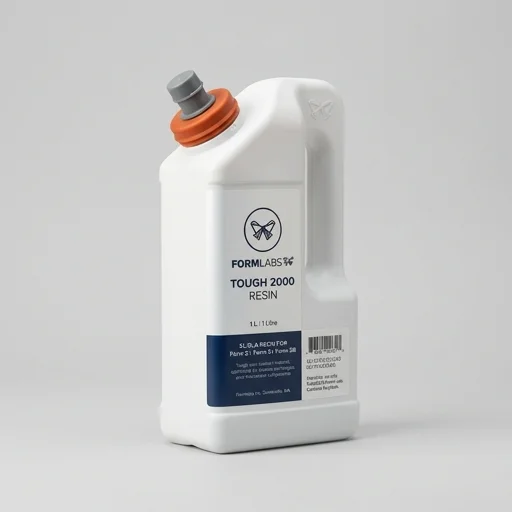
Formlabs Tough 2000 Resin is a stereolithography photopolymer engineered for engineers and product designers who need parts that can withstand mechanical stress without cracking or deforming under load. Formulated as part of Formlabs' Engineering Resin line, it mimics the performance of polypropylene, delivering high stiffness alongside impressive toughness so it can absorb impact and repeated flexing rather than snapping. This makes it particularly well suited for prototyping snap-fit assemblies, living hinges, enclosures, and functional components that need to survive real-world handling and testing during the product development cycle, all while maintaining the fine surface detail and dimensional accuracy that SLA printing is known for.
On the bench
Compatible with Formlabs' Form 3, Form 3+, Form 3L, and Form 4 series printers, Tough 2000 Resin is designed to be dispensed and cured using the same streamlined workflow as other Formlabs materials, working seamlessly with PreForm software for print setup and support generation. The resin cures into parts with a high elongation at break and notable resistance to fatigue, meaning printed components can endure multiple stress cycles without showing signs of wear or failure. Its balance of stiffness and flexibility sits between Formlabs' Tough 1500 and Tough 2000 predecessors and other engineering resins in the catalog, giving users a material tuned specifically for applications where both rigidity and impact resistance are equally critical, such as housings that need to protect internal electronics or brackets that must flex slightly without breaking.
Living with it
Post-processing follows the standard Formlabs ecosystem, requiring IPA washing to remove uncured resin and post-curing in a Form Cure unit to achieve full mechanical properties, ensuring consistent results batch after batch. The resin is packaged in Formlabs' standard cartridge format for tool-free loading into compatible printers, minimizing waste and mess during the printing process. Because it closely replicates the behavior of production-grade polypropylene parts, Tough 2000 Resin is frequently chosen by teams in automotive, consumer electronics, and industrial design who need functional prototypes or low-volume end-use parts that can be tested for durability, drop resistance, and repeated mechanical use before committing to expensive injection-molded tooling.