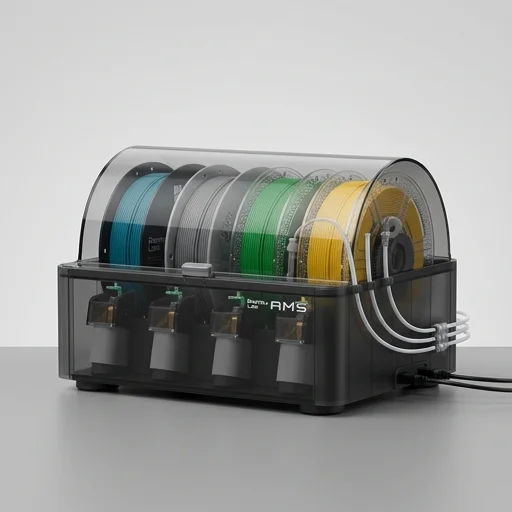
The Bambu Lab AMS, or Automatic Material System, is a multi-filament management unit designed to work seamlessly with Bambu Lab's line of 3D printers, including the X1 Carbon, X1, and P1 series machines. This accessory houses up to four spools of filament simultaneously, feeding them through a coordinated system that allows printers to switch between colors and materials automatically during a single print job. Rather than manually swapping spools and reslicing models, users can queue multicolor or multi-material prints and let the AMS handle the transitions, making it a genuine workflow upgrade for anyone producing detailed, multi-tone models or functional parts that combine different filament types.
On the bench
Inside the unit, each spool sits in its own humidity-controlled bay, and the AMS actively monitors filament moisture levels, which is a common pain point for materials like PETG, TPU, and nylon that degrade quickly when exposed to ambient air. Integrated sensors track remaining filament length and detect breaks or runouts, automatically pausing the print and switching to a backup spool of the same material if one is loaded, so long prints are far less likely to fail due to a spool running dry overnight. The buffer tubes and feeding mechanism are engineered to reduce friction and tangling, which helps maintain consistent extrusion pressure even as the printer alternates rapidly between colors on complex models.
Living with it
Setup is designed to be plug-and-play with compatible Bambu Lab printers, connecting via a dedicated port and communicating directly with the printer's firmware and slicer software, Bambu Studio, which automatically generates the necessary color-change instructions and purge routines when a multi-material model is sliced. Multiple AMS units can be daisy-chained together for users who want access to eight, twelve, or even sixteen simultaneous filament options, scaling the system for hobbyists experimenting with gradients and cosplay props as well as small businesses producing branded multicolor parts at volume. Overall, the AMS transforms multicolor and multi-material 3D printing from a labor-intensive, error-prone process into something closer to a hands-off, print-and-walk-away experience.